
I am Harpreet. I grew up in Punjab, the land of five rivers in northern India. I completed my bachelor’s degree in Biochemistry from DAV University, Jalandhar. For my master’s, I left my home state and moved to Uttarakhand to study at the Indian Institute of Technology Roorkee, a town shaped by the flow of the Ganga through the Upper Ganga Canal. At IIT Roorkee, my research focused on the intricate interactions between worms and bacteria.
In 2024, I joined Grégoire Michaux’s lab under the supervision of Anne Pacquelet at the Institute of Genetics and Development of Rennes (IGDR), located in Rennes, France. The city is vibrant mix of old and new, the two rivers Ille and Vilaine meet here. My research here focuses on the formation of microvilli during development.
All life requires energy to sustain itself. From trillion-celled humans to tiny worms no larger than a comma on a page, survival follows the same rule: food must be absorbed, not merely eaten. To achieve this, intestinal epithelial cells form countless microscopic protrusions called microvilli. These structures dramatically increase the absorbing surface area, transforming a flat cellular surface into a dense, functional brush border. Without microvilli, nutrients would largely pass by unused and absorbing food would be like trying to clean up a spill with a plastic sheet rather than a paper towel. The food is present but nutrients are much less absorbed and retained. Consistently, genetic diseases that prevent microvilli formation such as microvillus inclusion disease (MVID) or infection with pathogenic bacteria which lead to microvilli effacement are associated with severe nutrient absorption defects.
Despite the critical role of microvilli, the mechanisms underlying their formation and maintenance remain poorly understood. My project focuses on understanding how microvilli form during development. To this end, I am studying the developing intestine of tiny C. elegans worms. Similar to what happens in other animals, C. elegans survival, growth, and lifespan depend on microvilli performing their quiet but essential work efficiently. Structurally, microvilli are composed of actin filaments and actin-binding proteins. My work centers on characterizing the role of these actin-binding proteins, particularly of members of the myosin I family, called HUM-1 and HUM-5 in C. elegans, to understand how cytoskeletal organization drives microvillar assembly and function.
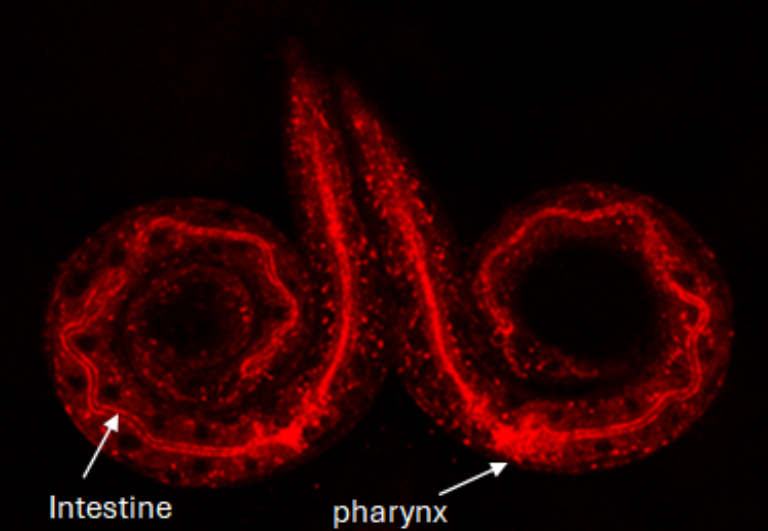
Figure 1. Two worms curled opposite each other showing the expression of the homolog of Myosin 1E (HUM-1, in red) in the intestine and pharynx.
Overall, my project will help in decipher mechanisms behind formation of microvilli, broadening our understand of these tiny structures.

