
Hello! I’m Abdul Mateen, a Marie Skłodowska‑Curie PhD Fellow within the SurfEx Marie Curie project, based at Bac3Gel and Instituto Superior Técnico in Lisbon. Before joining SurfEx, my scientific path revolved around microbiology; from studying microbial‑derived prebiotics and biofertilizers to understanding how beneficial bacteria influence health and the environment. Exploring how prebiotics modulate complex microbial communities in animals sparked my fascination with the human gut microbiome.
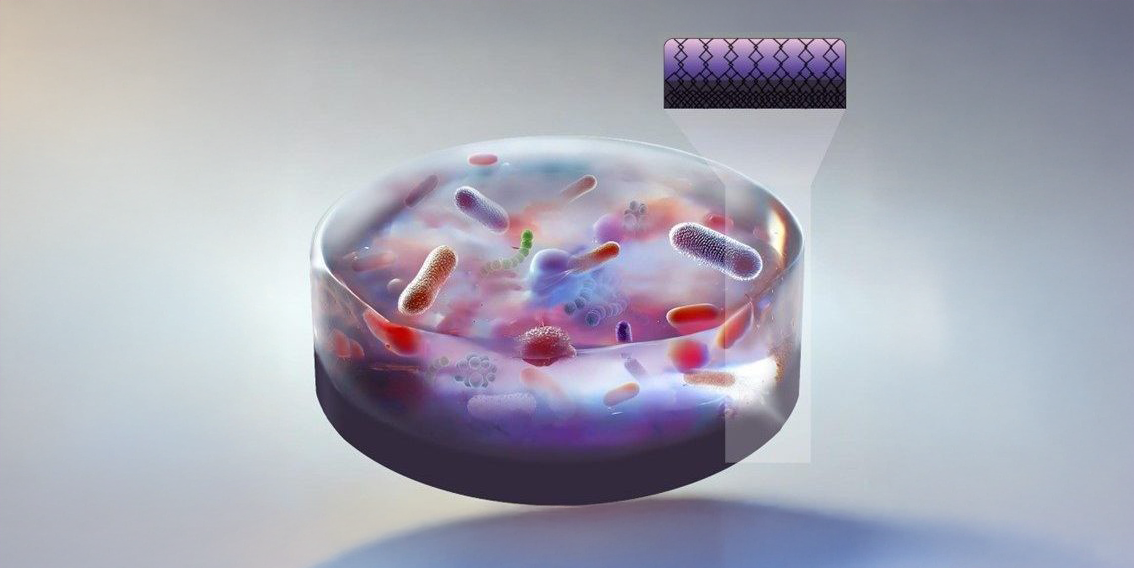
There are trillions of microbes that live in our gut, and their activity helps us digest food, produce vitamins, train immunity and influence most aspects of our health. In a healthy human gut, a mucus layer covers the top (apical) side of the epithelium, extending from the small intestine to the rectum. This mucus layer acts as a material exchange portal and hosts naturally occurring, beneficial microbes. It also serves as a barrier to prevent harmful (pathogenic) microbes from reaching the epithelial layer. So, it creates a balance between the helpful microbes and potential pathogens. When this balance is disrupted, as seen in Inflammatory Bowel Disease (IBD) – including Crohn’s disease and ulcerative colitis – the mucus loses its integrity losing its capacity to prevent microbes to reach the epithelium. This leads to inflammation and tissue damage in the gut. Inflammatory bowel disease is becoming more common with increasing complications and burdens patients for life. Because some of the earliest events happen at the mucus barrier, we need a human-relevant, well-controlled mucus model to study these mechanisms safely and precisely. With it, we can pinpoint first-hit drivers, test microbiome and drug effects, and design smarter therapies that actually translate to patients.
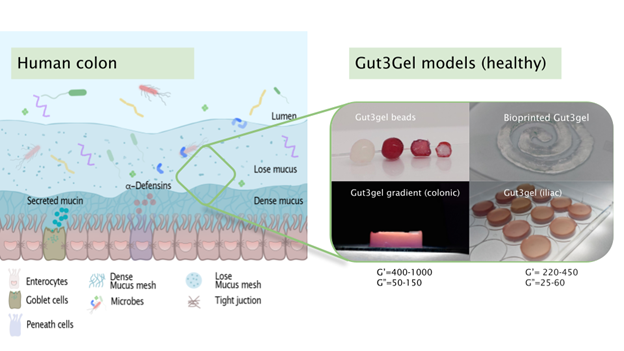
Figure 1: Healthy colon diagram showing a two-layer mucus, goblet-cell mucin secretion and intact tight junctions. The inset includes photos of healthy-state Gut3Gel models used to model the gut mucus in vitro, including Gut3Gel beads, bioprinted Gut3Gel, gradient Gut3Gel, and homogenous Gut3Gel.
In SurfEx, my research lies at the intersection of microbiology, biomaterials, and human health, focusing on how the gut microbiota interacts with the mucus barrier in diseased states. Specifically, my aim is to uncover how gut microbes adapt within healthy and diseased mucus environments and ultimately bridge the gap between laboratory systems and patient conditions. To achieve this, I am modifying an already existing healthy-state mucus model, called Gut3Gel, to transition towards the properties of diseased-state mucus. By tuning parameters such as the composition, stiffness and viscoelasticity of Gut3Gel, I can reproduce disease-like mucus characteristics and investigate how changes in these parameters affect microbial growth, metabolism, and barrier function in a new model named IBD-Gut3Gel. Currently, I am characterizing the physicochemical properties of IBD-Gut3Gel and conducting microbial culture experiments. These experiments include studying the activity within IBD-Gut3Gel of representative imbalance-state species such as Bifidobacterium adolescents and Bacteroides fragilis. Compounds that can strengthen or weaken the mucus barrier are identified by testing different luminal molecules. Ultimately, it will offer insights into drug-mucus interactions and how the body will potentially handle drugs targeting IBD.
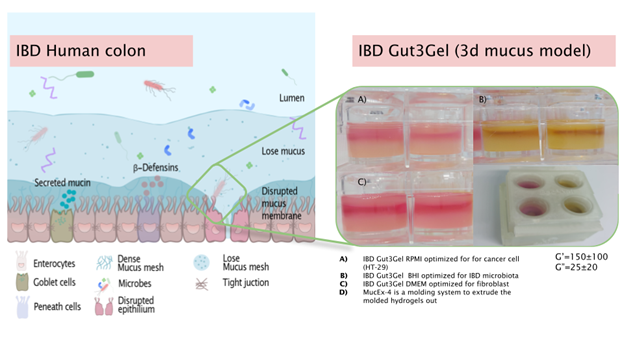
Figure 2: IBD colon schematic with thinned/patchy inner mucus, microbial encroachment, disrupted tight junctions, and epithelial damage, alongside photos of IBD Gut3Gel variants (A–D) in wells and a mold, used to mimic disease-like mucus properties for in-vitro studies.
The implementation of IBD-Gut3Gel will deepen our understanding of how Inflammatory Bowel Disease (IBD) starts and spreads in the gut. Ultimately, it will accelerate the development of more effective, non-animal based therapeutic strategies. With the support of SurfEx, I am thrilled to collaborate with like-minded people who share the vision of improving gut health and patient outcomes.
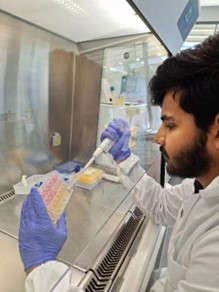
Figure 3: Abdul Mateen working with the IBD Gut3Gel

